

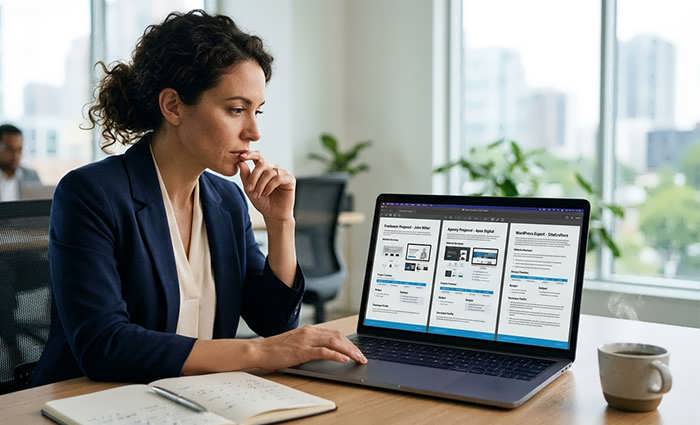
Your website is doing one of two things right now — building trust at every click, or quietly sending visitors straight to a competitor who built theirs properly. The difference almost always comes down to who wrote the code. Hiring the wrong WordPress developer costs you more than money; it costs you momentum, search rankings, and credibility that can take years to rebuild.
This guide gives you exactly what most articles won’t: a straight-talking breakdown of what to look for, what to avoid, and how to make the right hire — whether you’re starting from scratch or rescuing a site that was handed off badly.
Why Hiring the Right WordPress Developer Changes Everything
WordPress powers over 43% of all websites on the internet. That ubiquity is a double-edged sword. Because the platform is so accessible, the market is flooded with people calling themselves WordPress developers when they can barely edit a theme template without breaking the mobile layout. Every business owner we talk to has a version of the same story: a developer who vanished mid-project, a site that scored 28 on Google PageSpeed after launch, a WooCommerce store that buckled under light traffic.
Skilled WordPress experts build differently. They know the difference between a page builder shortcut that works fine on a brochure site and one that will quietly destroy your Core Web Vitals score the moment traffic picks up. They write clean, documented code that the next developer can actually read. And critically, they understand that a WordPress site is not a finished product. It’s a living system, and it needs solid foundations from day one.
In our projects, we’ve seen clients who invest in properly vetted WordPress development from the start typically spend 60–70% less on bug fixes, performance recovery, and emergency patches over the following 18 months compared to those who went with the cheapest bid.
What Type of WordPress Developer Do You Actually Need?
Before you post a brief or make a single call, answer this honestly: What kind of work are you actually hiring for? Most business owners treat all WordPress work as interchangeable. It isn’t. Hiring someone brilliant at custom PHP plugin development for a project that really needed a Gutenberg block specialist — or a visual designer who’s great with Elementor but has never touched the WordPress REST API — is a mismatch that costs time and money to undo.
Imagine a local restaurant owner who wants to launch online ordering integrated with their existing reservations system. That’s a full-stack WordPress development problem — it requires WooCommerce expertise, third-party API integration, mobile performance optimisation, and likely custom plugin work. A generalist who “knows WordPress” isn’t the right fit. A dedicated WordPress developer with e-commerce and integration experience absolutely is.
The Three Core Specialisations
- Frontend / Theme Developers — Specialise in visual output: custom Divi or Elementor builds, pixel-perfect design implementation, and responsive layouts. Best for brand refreshes, landing pages, and design-system rollouts.
- Backend / Plugin Developers — Work in PHP, WordPress hooks and filters, and the REST API. They build custom functionality, extend WooCommerce, and create bespoke plugins. Best for complex integrations, membership platforms, and custom post types.
- Full-Stack WordPress Programmers — Comfortable across the entire stack, including server configuration, database optimisation, and security hardening. Best for large builds, headless WordPress setups, and performance-critical projects.

The Vetting Process That Actually Works When You Hire WordPress Developers
Most hiring mistakes happen because evaluation focuses on soft signals — a polished portfolio, a friendly tone on a call — rather than actual technical evidence. Here’s the framework that separates genuinely skilled developers from well-presented ones.
Send a technical brief, not just a job description. Describe a real problem — “Our site loads in 7 seconds on mobile; what’s your diagnostic process?” — and evaluate the quality of their thinking, not their enthusiasm.
Ask for work samples relevant to your project. If you’re building a WooCommerce store, ask to see a WooCommerce project, then run that live site through Google PageSpeed Insights yourself. The numbers don’t lie.
Test communication before you commit. Ask a nuanced question by email and notice how long the response takes and whether it’s actually thoughtful. Communication quality before the project starts predicts communication quality during it — almost without exception.
Ask about their development stack and workflow. A developer who can tell you which caching solution they prefer and why, how they manage staging environments, and what their deployment process looks like is demonstrating real expertise — not just platform familiarity.
Probe their security awareness. Any competent WordPress programmer should speak fluently about sanitising user inputs, managing user roles correctly, and why even minor updates need a staging environment first.
Clarify post-launch support before you sign anything. What happens when something breaks after handoff? This conversation alone tells you a great deal about how professional they actually are.
Red Flags to Avoid When You Hire WordPress Programmers
Not every warning sign is obvious. Some of the worst project outcomes we’ve seen came from developers with impressive-looking portfolios. Watch for these:
- Excessive plugin dependency for basic functionality. Reaching for a plugin every time a feature is needed signals an inability to write PHP. It creates site bloat, security vulnerabilities, and plugin conflict problems that compound over time.
- No mention of Core Web Vitals or performance benchmarks. If a developer never references Largest Contentful Paint, Cumulative Layout Shift, or Time to First Byte in a performance conversation, they’re not optimising for Google — they’re just making things look presentable.
- Vague timelines with no milestone structure. “Should be ready in a few weeks” is not a project plan. Professionals give you phases, deliverables, and clearly defined revision windows.
- No questions about your business goals. A developer who jumps straight into technical specs without asking about your conversion goals, target audience, or SEO priorities is building something for themselves — not for your business.
- Resistance to using a staging environment. Making changes directly to a live WordPress site without staging first puts your uptime and data at risk. This is non-negotiable for any professional.
Honest advice: If you’re evaluating three developers and one is significantly cheaper with no clear reason why, that price difference is almost always explained by something that will cost you more later — scope creep, missing features, poor code quality, or an abandoned project. The discount is always priced in somewhere.
Freelancer vs. Dedicated WordPress Developer vs. Agency: Which Model Is Right for You?
This is the question most articles skip entirely, so here’s a direct answer.
A freelancer makes sense when:
You have a clearly scoped, time-bound task — a plugin fix, a speed audit, a design update. Freelancers are lean, often highly specialised, and cost-effective for contained work. The risk is availability: they juggle multiple clients and may not be free for urgent follow-ups when you need them.
A dedicated remote WordPress developer makes sense when:
You need someone embedded in your workflow for an extended period — building a complex product, supporting an internal team, or maintaining a site with regular feature releases. Dedicated developers give you continuity, growing knowledge of your codebase, and predictable capacity. This model scales well and makes budgeting straightforward.
A WordPress development agency makes sense when:
Your project needs multiple disciplines running in parallel — UX design, backend development, QA testing, and project management — or when you want strategic input alongside hands-on execution. Agencies carry higher day rates but lower overall risk on complex builds. For businesses where the website is a revenue-critical asset rather than a digital brochure, this is consistently the highest-ROI model.

What Genuine WordPress Development Services Look Like in 2025
The landscape has shifted significantly. Hiring WordPress experts today means looking beyond whether someone can install and configure a page builder. The most valuable WordPress developers combine traditional CMS development with working knowledge of performance architecture, headless and decoupled setups using the WordPress REST API or WPGraphQL, accessibility standards (WCAG 2.2), and privacy-compliant tracking as third-party cookies continue their phase-out.
Clients often ask us whether they should go headless — separating the WordPress backend from the frontend rendering layer using React or Next.js. Our honest answer: for most business websites, the performance and editorial benefits don’t justify the added complexity and cost unless you’re running a high-traffic content operation or need multi-channel content distribution. A well-built, properly optimised traditional WordPress site will outperform a poorly implemented headless build every time. Know what you actually need before chasing what’s technically fashionable.
One angle almost no one talks about: developer documentation is a deliverable, not a bonus. When you hire WordPress developers for any significant project, insist on code comments, a handoff document explaining key architectural decisions, and a plain-English admin guide for your team. Without it, every future change becomes an archaeology project — and you’re back paying someone to reverse-engineer decisions that could have been explained in an afternoon.
Frequently Asked Questions
How much does it cost to hire a WordPress developer?
Rates vary by experience, specialisation, and engagement model. Vetted freelancers with proven track records typically charge $70–$150 per hour. Dedicated remote WordPress developers on monthly retainers commonly run $2,500–$6,000 per month, depending on seniority and scope. Full project builds through a specialist agency typically start at $5,000–$10,000 for a mid-complexity website. The right number isn’t the lowest available — it’s the one that reflects the quality your project actually requires.
What is the best way to hire dedicated WordPress developers?
Define the scope before you start. Know whether you need frontend, backend, or full-stack expertise—vet technical ability with real-world questions, not just portfolio browsing. Check live work, not screenshots. Confirm communication quality during the evaluation stage — it’s the single most predictive factor for a smooth project. And always establish clear post-launch support terms before work begins.
How do I know if a WordPress developer is genuinely skilled?
Ask technical questions that require demonstrated knowledge, not just enthusiasm. Run any live site they show you through Google PageSpeed Insights. Ask them to walk you through how they’d approach your specific brief — a developer who asks clarifying business questions before talking about technology is the one to hire. Watch how they discuss trade-offs; strong developers know when not to use a particular tool or approach, and they’ll tell you so.
Ready to Work With WordPress Experts Who Build Sites That Actually Perform?
Stop settling for developers who deliver something that looks right but quietly underperforms where it matters. We build WordPress sites engineered for speed, search visibility, and long-term growth — and we’d love to do the same for yours.



0 Comments